
Greece produces some of the finest olive oil on earth – yet most of it gets sold off in bulk to Italy. Here’s what’s actually in those bottles, and how to find the real thing.
In this post
- Why Greek olive oil is genuinely different
- The regions that matter
- The Koroneiki variety – and why it’s the king
- What “extra virgin” actually means
- The harvest secret: agourelaio
- Health benefits (the real ones)
- What to buy — and what to avoid
Spend any time in a Greek kitchen, or at a Greek table, and you’ll notice something: olive oil isn’t a condiment. It’s not drizzled. It’s poured. Generously. Into everything. Greeks don’t use a couple of tablespoons; they use a cup. And they’ve been doing it for roughly 5,000 years.
So why does the rest of the world keep reaching for Italian or Spanish oil? The short answer: marketing. The longer answer involves bulk exports, blended bottles, and a branding story Greece is only just beginning to tell properly.
Let me fix that.
Why Greek olive oil is genuinely different
80%
of Greek olive oil is extra virgin – the highest-quality grade
130M+
olive trees in Greece – producing fruit for centuries
24kg
average annual olive oil consumption per Greek person
Spain is the world’s largest olive oil producer, Italy is second, and Greece is third. Yet, volume tells the wrong story. What makes Greece exceptional is quality, not quantity. Between 75 and 80 percent of total Greek production qualifies as extra virgin, a figure that dwarfs Italy and Spain. The difference comes down to how Greek olives are grown and harvested: mostly on small family plots, on steep or difficult terrain, picked largely by hand, and delivered quickly to small local mills. This isn’t romantic tradition for tradition’s sake, it produces genuinely lower-acidity, higher-quality oil.
Here’s the part that might surprise you: much of that premium oil gets exported in bulk to Italy, where it’s blended and bottled under Italian labels. Greece has historically been more grower than marketer. That’s finally changing, and a new generation of Greek producers is now bottling and branding their own oil properly.
The regions that matter
Olive trees grow all over Greece — they’re on every island, in every region, along roadsides and in people’s backyards. But serious production is concentrated in a few areas:
Peloponnese
The gold standard. The area around Kalamata, particularly Koroni, is considered the finest growing zone. Family farms, hand-harvested, exceptional quality.
Crete
Personal favorite. Diverse terroir from coastal plains to mountain valleys. Excellent Koroneiki production; has the longest growing season in Greece.
Mytilini (Lesvos)
Corfu
The Koroneiki variety and why it’s king
If Greek olive oil has a hero, it’s the Koroneiki olive. Named after the town of Koroni in the Peloponnese, this tiny olive grows on mountain slopes, produces a high skin-to-flesh ratio, and delivers the intensely fruity, peppery, aromatic oil that olive oil lovers chase. It accounts for roughly 60–80% of all Greek olive oil production — and it’s the reason Greek oil has such a distinct flavor profile compared to the milder Spanish and Italian blends most people are used to.
“The Koroneiki’s high ratio of skin to flesh is exactly what gives Greek oil its coveted aromatic qualities. It’s not an accident, it’s the variety.”
Varieties you can get here in the USA, Mythologia, Iliada, Tera Creta and the one we often have in our home in Greece is called “Spitiko” which literally translates to “homemade.” We also use Molon Lave olive oil at home in Greece.
Greece has over 50 recognized olive cultivars, many with DNA lineages so old and tangled that the same variety goes by different names in different villages.
BRANDS WORTH BUYING
Mythology -PDO Kolymvari, Crete · everyday workhorse · great value in the 3L tin
Spitiko – Greek extra virgin olive oil · simple, authentic, and what most people think they’re buying when they picture “real” olive oil
Terra Creta – PDO Kolymvari, Crete · #1 ranked Greek EVOO · priced to actually cook with.
Iliada – Koroneki PDO · smooth, balanced, and a dependable staple you can use every day
*another would be Molon Lave
Health benefits (the real ones)
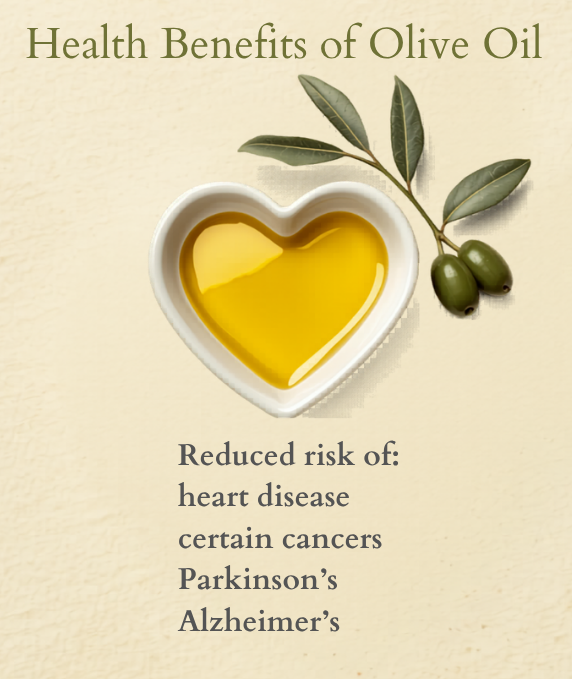
Greek olive oil sits at the center of the Mediterranean diet – which has the most robust evidence base of any dietary pattern for longevity and disease prevention. The specific benefits tied to high-quality EVOO: monounsaturated fats that raise HDL (good) cholesterol while lowering LDL, high antioxidant content, vitamins A, D, E and K, and, particularly relevant for early harvest and Koroneiki oils, oleocanthal compounds, which have demonstrated anti-inflammatory properties comparable to low-dose ibuprofen. Studies link regular olive oil consumption to reduced risk of heart disease, certain cancers, Parkinson’s, and Alzheimer’s.
This isn’t trendy wellness talk. Greeks have been eating this way for millennia. The data caught up with the culture.
What to buy and what to avoid
A few rules from someone who’s been in Greek kitchens for many years:
Look for: Greek origin clearly stated (not “bottled in Greece” but – produced in Greece). Single estate or single region. PDO designation where applicable. Dark glass bottles or metal tins. Harvest date on the label (not just a best-before date). Koroneiki variety if you want intensity.
Avoid: Anything that says “a blend of EU olive oils” without naming the country. Oversized plastic containers unless you’re cooking in volume and using it fast. Clear glass bottles on a sunny shelf. Any bottle that doesn’t tell you where the olives came from.
And one thing I always tell people: if you go to Greece, make sure you have space in your luggage for the things you will want to bring home. The everyday table oil from a local producer’s farm stand will likely be better than anything you can buy at home, and it costs almost nothing there. Bring the large zip-lock bags for packing liquids.
Planning a trip to Greece and want to know which regions to visit, which producers to look for, or how to build a food-focused itinerary? That’s exactly what I do.