Not All Feta Is Created Equal.
Not Even Close.
A crash course in what you're actually buying at the supermarket, why most of it barely qualifies, and what the real thing tastes like when it's done right.
Let’s start with the uncomfortable truth: if you’ve been buying the crumbled stuff in the little flimsy or green plastic tub, you’ve been eating cow’s milk cheese with a Greek accent. It’s not feta. It’s not even trying that hard. It’s just… white and crumbly and vaguely salty, and someone’s marketing team decided that was close enough.
Real feta has a 3,000-year head start on that nonsense. Here’s what you need to know.
What’s actually in the dairy aisle
In the United States, the word “feta” on a label doesn’t mean much legally. The EU has protected designation of origin (PDO) rules that restrict the name to cheese made in specific Greek regions from sheep’s milk – but that protection doesn’t apply in America. So American producers can call whatever they want feta, and they do. (smh)
WHAT YOU’LL FIND
American "feta" - block
WHAT YOU’LL FIND
Pre-crumbled cow's milk
THE REAL THING
Greek PDO Feta
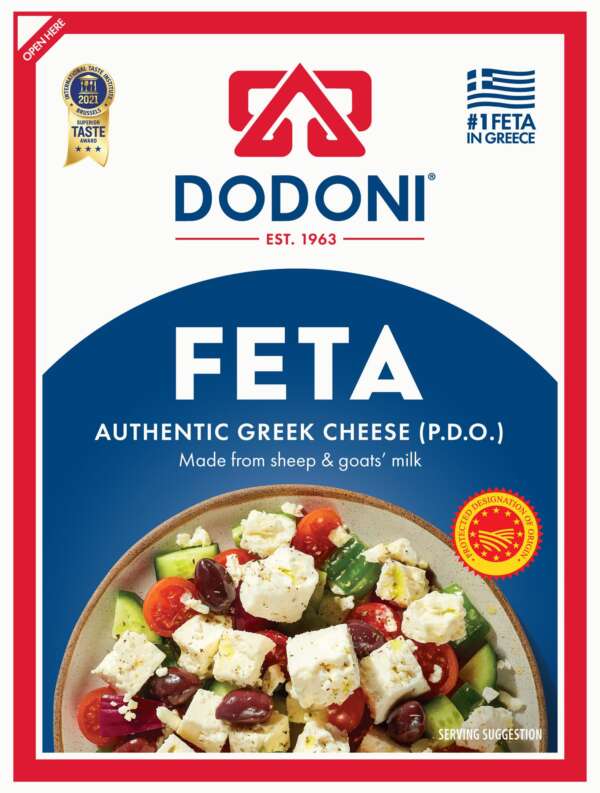
Look for the blue and yellow EU PDO seal on imported Greek feta. Brands like Dodoni, Mt. Vikos, and Epiros are solid and widely available in the US. Yes, they cost a little more. Yes, it’s worth it.
Real feta is sold in blocks and in brine. If it’s pre-crumbled in a plastic tub, it has already told you everything you need to know.
Why sheep’s milk changes everything
Sheep’s milk has significantly more fat and protein than cow’s milk — which gives real feta its dense, creamy texture and its characteristic tang. The sheep and goats grazing on the specific plants and grasses of the Greek landscape add to the flavor profile in ways that simply cannot be replicated with Holstein cows in Wisconsin. The EU’s PDO designation isn’t bureaucratic fussiness. It’s flavor science.
The lactic acid bacteria naturally present in raw sheep’s milk also do a lot of the flavor work during aging — which is why traditionally made village feta, using unpasteurized milk, has a depth and complexity that even good commercial Greek feta can’t fully match.
How they make it in the villages
I’ve watched this process firsthand, and it’s as old as it sounds. The basic principles haven’t changed in centuries.
How we eat it
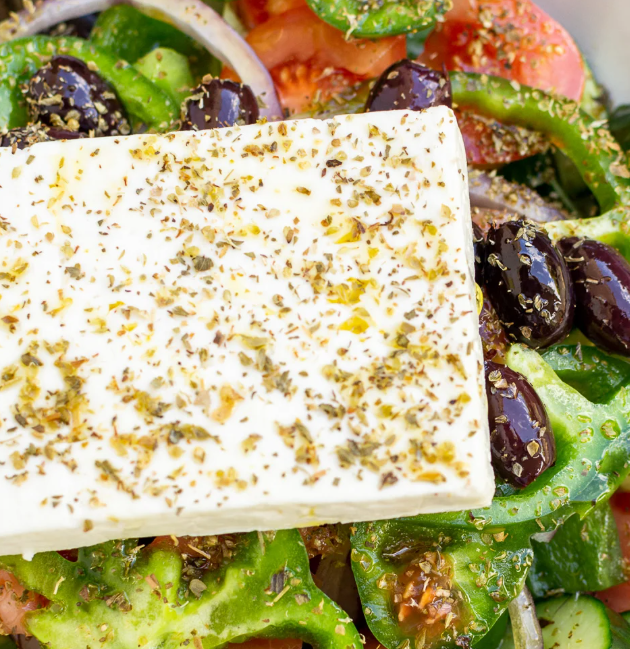
We eat it with everything except certain fish. It is on every table alone or in a Greek salad, feta is as much a staple as bread, salt and peper.
When it comes out of that brine after a year of slow aging, it has developed a sharpness and complexity that no factory process can shortcut. The texture is firm but gives. The flavor is bold, salty, tangy, with a richness that is hard to describe. If you’ve only ever had the tub stuff, I promise you: it is not the same food.
A MEMORY FROM THE VILLAGE
Yiayia would bake enormous loaves of bread, the kind that filled the whole kitchen with warmth and smell. When it came out of the oven, she’d cut thick slices and lay thick slices of feta alongside them for the kids. For the adults, she’d add salted tomatoes drizzled with olive oil and a pinch of wild sun-dried oregano on top. That was it. That was the whole thing. And it was one of the best things I’ve ever eaten.
There was no recipe. There was no technique. There was just good bread, real feta, a ripe tomato, honest olive oil, and oregano. The feta did all the work. It was salty and sharp and creamy all at once, and it tasted like somewhere specific, -not like “white crumbly cheese flavored product.”
That’s what PDO means in practice. It means the cheese carries a place in it. The land, the animals, the process, the time. You can taste all of it. And once you do, you’ll stop buying the plastic container.
Planning a trip to Greece and want to eat like a local? Book a consulting session I’ll tell you exactly where to go and what to ask for.
What to buy
When you’re shopping, look for Greek feta packed in brine, with the EU PDO label. It’s usually in the specialty cheese section or the international aisle. If you see a container of pre-crumbled domestic feta on sale next to it, leave it there. You now know better.
And if you ever find yourself in Greece, or in a Greek village kitchen with bread fresh from the oven (lucky you!) – say yes to whatever’s being offered. No matter what it is.